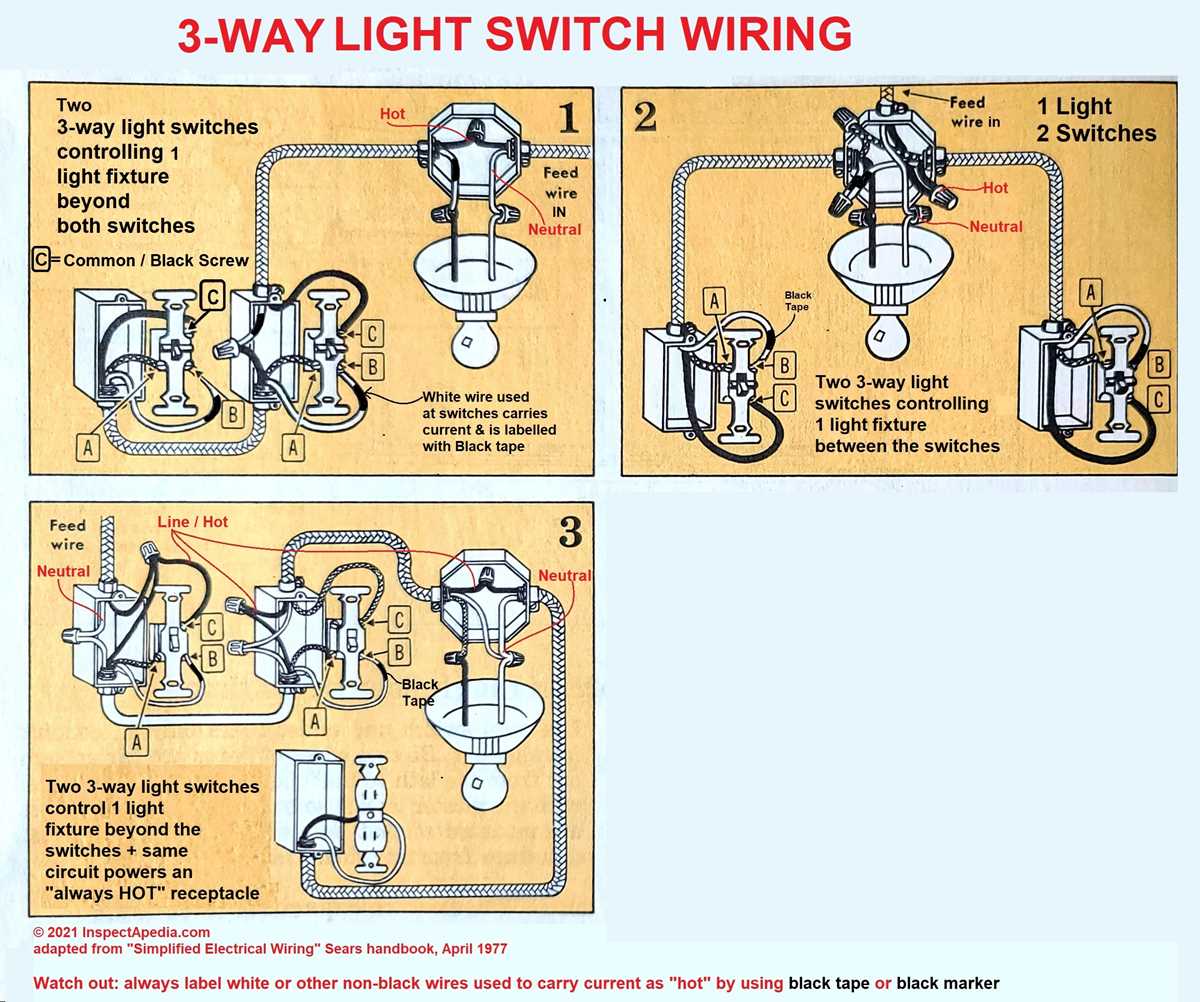
Use a pair of two-way wall controllers and a three-conductor cable between them to operate a single ceiling fixture from two locations, such as the bottom and top of a staircase. The phase conductor from the power source connects to the common terminal of the first control unit. From there, two traveler conductors run toward the second unit, forming an alternate path that allows the fixture to change state whenever either control key is pressed.
The second wall controller receives the two traveler conductors on its paired terminals, while its common contact leads directly to the lamp holder. The neutral conductor bypasses both control devices and connects straight to the fixture. This arrangement ensures the bulb receives power only when the internal contacts of both devices create a closed electrical path.
Typical conductor identification helps prevent mistakes during installation. In many residential systems, the phase is marked brown or black, neutral is blue, and the traveler pair may use black and grey insulation. Each terminal screw should be tightened firmly, because loose contacts cause heat buildup and intermittent operation.
Mount both wall units at a comfortable height–usually 90–110 cm from the floor. Keep cable routes inside protective conduit or approved wall channels. After completing the connections, restore power and test the setup: pressing either control key should toggle the ceiling fixture regardless of the position of the other unit.
Wiring Diagram 1 Light 2 Switches: Step-by-Step Layout and Connections
Connect the phase conductor from the distribution box to the common terminal of the first control unit, then route two traveler conductors from that device to the corresponding terminals of the second control unit. The common terminal of the second unit must feed the lamp holder phase input, while the neutral conductor runs directly from the supply box to the fixture. This arrangement allows the lamp to be toggled from either control location without interrupting the neutral path.
Use a three-core cable between the two wall controllers. Label the conductors before installation: L1 and L2 for the travelers, and COM for the common terminal. Inside the first device, connect the incoming phase to COM. The two remaining terminals receive L1 and L2. At the second device, attach the same two travelers to the paired terminals, and connect its COM terminal to the fixture’s phase lead.
Inside the ceiling box, join the neutral from the power supply directly with the neutral lead of the lamp holder using a terminal block rated for at least 16 A. The phase arriving from the second controller becomes the switched conductor. Ground wires from the supply, both wall controllers, and the fixture housing must be joined with a protective earth connector.
Keep conductor colors consistent: brown or black for incoming phase, grey and black for traveler lines, blue for neutral, and green-yellow for protective earth. Cable cross-section of 1.5 mm² copper suits most residential circuits rated up to 10 A. Route cables vertically or horizontally inside walls; avoid diagonal runs because later drilling becomes risky.
After completing connections, restore power and test both wall controllers individually: flipping either one must change the state of the lamp regardless of the position of the other. If the fixture only reacts from one location, the common terminal was likely placed on a traveler contact rather than the COM terminal.
How to Connect Two Wall Controls to Operate One Lamp Using a Standard Two-Way Layout
Use two 2-way wall controllers and a three-core cable between them so a single ceiling lamp can be operated from two locations such as the ends of a corridor or stairway. The incoming phase conductor must go to the common terminal of the first control device, while the common terminal of the second device feeds the luminaire. Two traveler conductors run between the paired terminals on both control units, allowing either control point to change the state of the circuit.
Terminal Arrangement
Each two-way control unit normally has three terminals: one marked COM (common) and two traveler contacts. The conductors must be placed carefully.
- Phase supply → COM terminal of the first control point
- Traveler A → terminal L1 on both control units
- Traveler B → terminal L2 on both control units
- COM of the second control unit → phase input of the ceiling lamp
- Neutral conductor → directly from distribution box to the lamp holder
This arrangement creates an alternating path for current. When one control unit changes position, the connection between COM and one traveler flips, altering which traveler carries the phase. If both control units select the same traveler conductor, the circuit closes and the lamp turns on; selecting opposite travelers breaks the path.
Cable and Safety Details
Choose cable types based on installation method. For concealed residential runs, a 3-core cable (phase travelers plus ground) between the control units and a 2-core cable from the second unit to the luminaire is typical. Conductor cross-section of 1.5 mm² copper is common in European residential circuits protected by a 10 A or 16 A breaker.
- Disconnect the circuit breaker before touching conductors.
- Verify absence of voltage using a tester.
- Mark the phase conductor so it is not confused with travelers.
- Connect grounding conductors to metal mounting boxes and the fixture frame.
- After installation, restore power and toggle each control point to confirm alternating operation.
With the conductors arranged this way, either wall control can change the state of the ceiling luminaire without depending on the position of the second unit. This configuration suits staircases, hallways, garages, and long rooms where access points are separated by several meters.