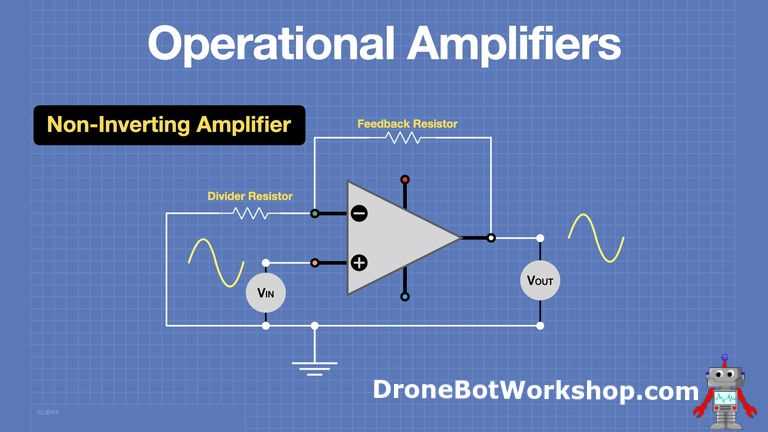
Connect the input signal directly to the positive terminal of an operational amplifier and build a feedback network between the output and the negative terminal using two resistors. This configuration keeps the output waveform in the same phase as the input while increasing signal magnitude according to the resistor ratio.
A common setup uses resistors R1 and R2 connected between the output node and ground. The gain of this voltage stage follows the relation Av = 1 + (R2 / R1). For example, selecting R1 = 10 kΩ and R2 = 90 kΩ produces a voltage gain of 10. Precision metal-film resistors help maintain stable amplification and reduce drift.
Operational amplifier chips such as LM358, TL071, or NE5532 operate well in this arrangement. Supply voltage often ranges from ±12 V dual rails or a single 5–15 V source depending on the device. Decoupling capacitors between supply pins and ground (typically 100 nF ceramic) prevent oscillation and maintain stable operation.
This topology is widely used for microphone pre-stages, sensor signal boosting, and audio input buffering. High input impedance–often above 1 MΩ–prevents loading of the signal source, while the feedback path defines predictable gain and output behavior.
Non Inverting Amplifier Circuit Diagram With Op Amp Connections and Gain Calculation
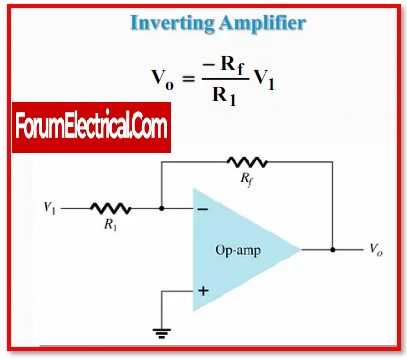
Feed the signal directly into the positive input pin of the operational amplifier and connect a feedback resistor network between the output node and the negative input. This arrangement keeps the output waveform aligned in phase with the incoming signal while increasing voltage magnitude according to the resistor ratio.
The feedback network normally uses two resistors. One resistor connects the output to the negative input, while the second resistor links that node to ground. This pair defines the voltage gain of the stage and stabilizes operation through negative feedback.
Voltage multiplication follows the formula Av = 1 + (R2 / R1). If R1 = 10 kΩ and R2 = 40 kΩ, the resulting gain becomes 5. Increasing the value of the feedback resistor raises output magnitude, while reducing it lowers amplification. Precision components with 1% tolerance maintain predictable signal levels.
Operational amplifier chips such as LM358, TL072, NE5532, and OPA2134 are commonly used in this configuration. Many designs operate with dual supply rails of ±12 V or ±15 V. Single-supply setups using 5–12 V also work when a bias reference shifts the input signal above ground.
High input impedance allows direct connection to sensors, audio sources, or signal generators without loading the source. Typical input resistance exceeds 1 MΩ, while the feedback path defines gain accuracy and bandwidth behavior.
Add 100 nF ceramic decoupling capacitors between each supply pin and ground close to the integrated circuit package. This prevents oscillation and high-frequency noise that may appear when long traces or unstable supply lines are present.
Pin Connections and Feedback Resistor Placement in a Non Inverting Op Amp Amplifier
Connect the input signal to the positive terminal of the operational amplifier while building the feedback path between the output node and the negative terminal. This wiring keeps the output waveform aligned with the input and allows the feedback resistors to control voltage gain.
Typical Operational Amplifier Pin Roles
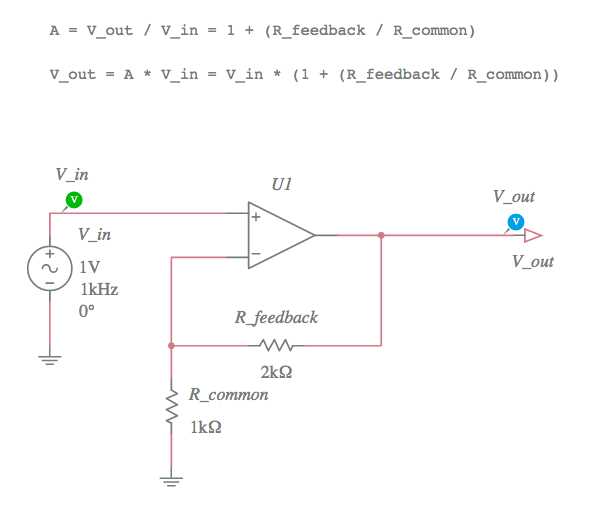
Most dual or single op-amp packages follow a standard pin structure. Correct identification of these pins prevents wiring mistakes that can lead to oscillation or zero output.
- Positive input receives the external signal
- Negative input connects to the feedback network
- Output pin delivers the amplified signal
- V+ positive supply rail
- V− or GND negative supply rail or ground reference
For example, in the LM358 integrated circuit, pin 3 receives the input signal, pin 2 connects to the feedback node, and pin 1 provides the output. The resistor linking the output to the negative terminal determines how strongly the device feeds back a portion of its output signal.
Feedback Resistor Network Placement
The resistor network must be placed directly between the output node and the negative terminal with minimal trace length. Long tracks introduce noise and may cause instability in high-gain configurations.
- Connect resistor R2 from output to the negative terminal
- Connect resistor R1 from the negative terminal to ground
- Apply the input signal to the positive terminal
- Route the output node to the load or next signal stage
Typical resistor values range from 1 kΩ to 100 kΩ. Lower values reduce noise pickup but increase current draw, while higher values reduce loading on the output stage. Many audio and sensor interfaces use 10 kΩ and 100 kΩ combinations because they provide stable gain while keeping current low.
Place 100 nF ceramic capacitors close to the supply pins to suppress high-frequency noise. Without these bypass components the operational amplifier may oscillate, producing unstable output or high-frequency distortion.