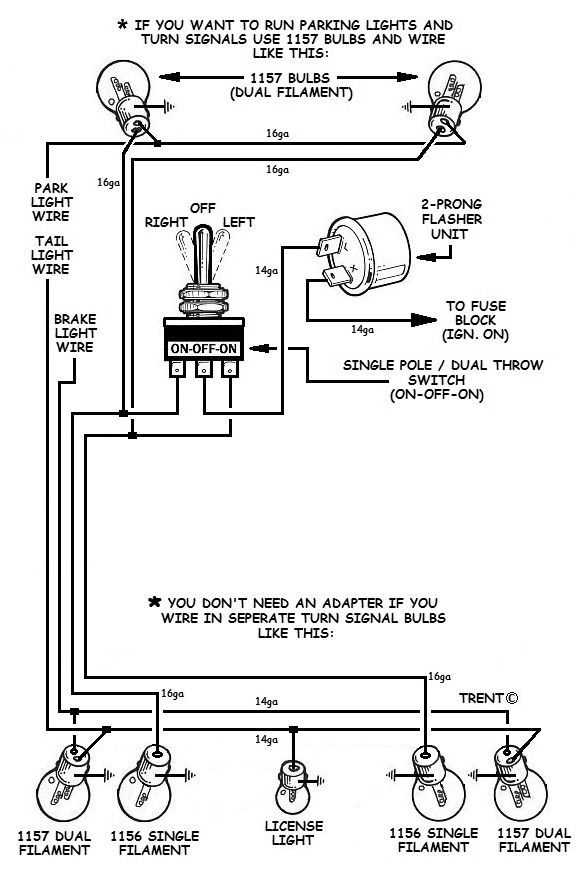
Ensure accurate identification of each conductor before connecting components to prevent misfires and uneven illumination. Use a multimeter to confirm continuity and check resistance values for proper operation.
Labeling leads and maintaining color consistency simplifies future maintenance and prevents cross-connections. Standard practice assigns green for left activation, yellow for right, and brown for ground, though variations exist depending on module type.
Connect the flasher unit directly to the power input while observing polarity. Incorrect attachment can cause rapid blinking or total failure. Use secure spade terminals and insulated connectors to maintain reliable contact under vibration.
Test each lamp individually after assembly to confirm correct sequencing. A functional system should illuminate one side at a time with consistent flash timing, and any irregularity indicates a misconnection or defective component.
Vehicle Indicator Installation and Connection Guide
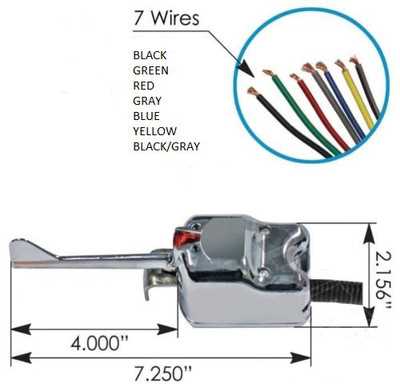
Begin by verifying the polarity of each conductor with a multimeter to prevent erratic flashing. Attach all leads to the control module only after confirming correct orientation.
Route the cables along the vehicle frame using insulated clips to avoid abrasion. Keep wires away from hot surfaces and sharp edges to prevent insulation damage.
Assign distinct color codes for left, right, and ground paths. Consistently mark green or blue for one side, yellow for the other, and brown or black for ground. Label connectors clearly to reduce installation errors.
Mount the flasher unit close to the main power input and ensure spade terminals fit securely. Loose connections can produce rapid or uneven blinking patterns and may damage the module over time.
Test each lamp individually after connecting to the module. Proper sequencing should illuminate one side at a time with uniform flash timing, revealing misconnected paths immediately.
Incorporate inline fuses near the main power feed to protect against shorts. Match fuse ratings to the combined current draw of all lamps to prevent overheating or conductor damage.
Perform a final inspection by activating each side in sequence while checking temperature and connector integrity. Ensure all insulation is intact and no exposed wires contact metal parts to maintain safety and reliability.
Identifying Conductor Colors and Functions in Vehicle Indicator Systems
Use a multimeter to verify each lead before connecting to the control module. Green and blue are commonly assigned to one side of the lamps, while yellow typically marks the opposite side. Ground paths usually employ brown or black insulation for easy identification.
Trace each cable from the flasher or controller to the respective lamps. Consistent color coding prevents misfires, uneven illumination, or cross-activation between left and right paths. Mark all connectors with adhesive labels to simplify maintenance and reduce errors during future inspections.
Confirm functional integrity by powering the module briefly and observing each lamp individually. Any deviation in flash sequence or intensity indicates an incorrect conductor, loose terminal, or potential short. Immediate correction ensures long-term reliability and prevents damage to the lighting module or vehicle electrical system.