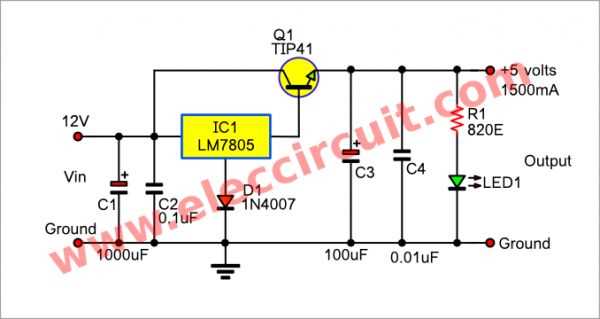
Use a high-quality linear module with thermal protection to maintain steady output when powering microcontrollers or small sensors. Ensure input sources are filtered to reduce ripple and prevent voltage spikes.
Select capacitors with low equivalent series resistance at the input and output terminals. This reduces transient drops and keeps output steady under varying load conditions. A 470µF electrolytic paired with a 0.1µF ceramic capacitor is recommended for typical setups.
Maintain a short and direct connection layout between components. Long wires or traces can introduce voltage drops and high-frequency noise, affecting sensitive devices powered by the module.
Check thermal dissipation requirements for the module. Even at moderate currents, heat can build up; using a small heatsink or airflow can prevent thermal shutdown and maintain a constant 5-volt output.
Include a reverse-polarity protection diode if the power source polarity may vary. This simple step prevents damage to the module and connected devices from accidental reverse connection.
5 Volt Regulator Module Setup and Connection Guide
Ensure input voltage remains within 7 to 12 volts to prevent module overheating or voltage drops. Use a stable DC source and add a 470µF capacitor near the input to smooth fluctuations and protect sensitive devices connected downstream.
Connect output terminals directly to load pins with short, thick wires to minimize resistance and voltage loss. Include a 0.1µF ceramic capacitor across output terminals to filter high-frequency noise and maintain stable operation under dynamic loads.
Verify polarity before powering the module and, if necessary, add a small Schottky diode in series to prevent reverse-current damage. For extended operation, attach a heatsink to the module’s metal tab or ensure adequate airflow to avoid thermal shutdown during continuous use.
Selecting Components for a Stable 5 Volt Power Supply
Choose a linear voltage controller or switching module rated for at least 1.5 times the expected load current to prevent thermal stress. Include input electrolytic capacitors between 470µF and 1000µF to reduce ripple and maintain steady input voltage during load spikes.
Optimize output stability using a combination of capacitors and protective elements:
- Place a 0.1µF ceramic capacitor across output pins to filter high-frequency noise.
- Use a low-value series resistor or ferrite bead if connecting sensitive sensors to suppress voltage oscillations.
- Consider a small Schottky diode in series to guard against reverse-current flow from connected modules.
- Ensure adequate heatsinking or airflow for components rated near maximum current to avoid thermal shutdown.