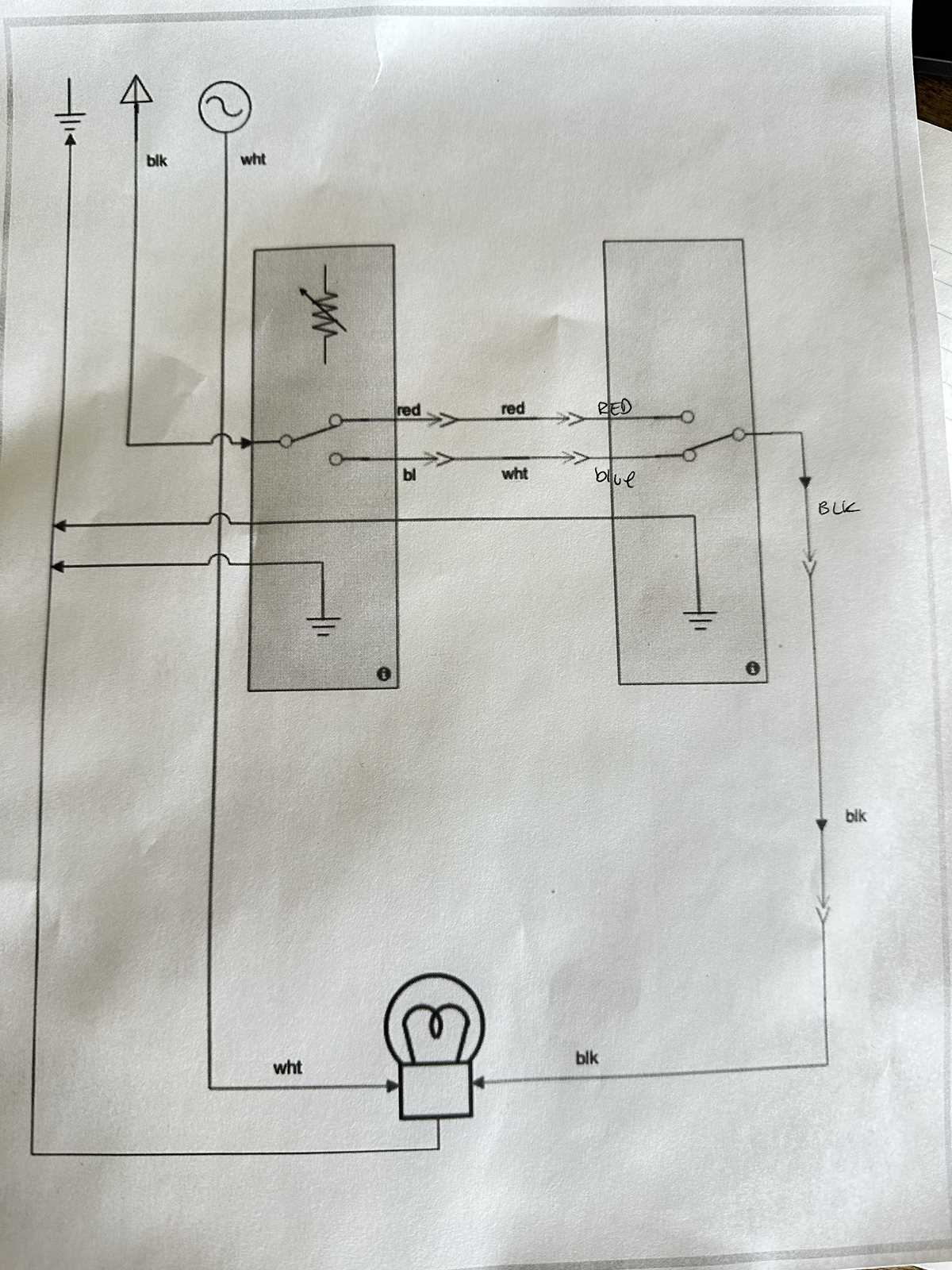
Use a dual-control lighting setup when one lamp must operate from two different wall controls, such as at the top and bottom of a staircase or at both ends of a long hallway. This arrangement relies on two control devices connected by traveler conductors that redirect the live line between terminals. The light fixture receives power only when the internal contacts of both devices align along the same path.
A typical residential installation uses three active conductors plus ground between the control points. One terminal receives the incoming phase from the electrical panel, while another sends power toward the lamp holder. Two intermediate wires carry the alternating path between the two controls. When either control is toggled, the electrical path changes and the lamp state flips from on to off or the reverse.
Correct terminal identification prevents wiring errors. The darker screw on each device marks the common contact, while the lighter screws connect to the traveler pair. Reversing these leads often causes the lamp to stay permanently on or off. A voltage tester helps confirm which conductor carries the live supply before any connection is made.
Use 14/3 or 12/3 cable in most North American homes depending on breaker rating, with the red and black conductors serving as the traveler pair and white used as neutral when routed to the fixture. Ground bonding between metal boxes, cables, and devices maintains electrical safety and reduces shock risk during operation.
3 Way Switch Circuit Diagram With Wiring Layout for Two Switch Light Control
Connect the incoming phase conductor to the common terminal of the first wall control and route the lamp feed from the common terminal of the second control. This arrangement allows the light fixture to change state from two locations such as stair landings, corridor ends, or large rooms with multiple entrances.
Use a three-conductor cable plus ground between the two control boxes. The red and black conductors serve as the traveler pair, transferring the live path between devices. The grounding conductor must be bonded to both metal boxes and to the green terminal on each control unit.
The wiring layout follows a predictable pattern. Incoming phase from the distribution panel enters the first control box. From there, two traveler lines run to the second box. The output lead from the second control goes directly to the lamp holder. The neutral conductor normally bypasses the control devices and connects straight to the fixture.
Identify the common terminal before attaching any conductor. Manufacturers mark it with a darker screw or a label such as COM. Connecting a traveler wire to that terminal leads to unstable lamp behavior, including a state where the fixture operates from only one location.
In a standard 120-volt residential lighting setup, electricians typically use 14/3 cable with a 15-amp breaker or 12/3 cable with a 20-amp breaker. The black conductor often carries the incoming phase, red works as the second traveler, and white remains neutral. Re-mark the white conductor with colored tape if it functions as a live lead.
Mount the first control near the entry point of the power feed. This reduces unnecessary cable length and simplifies troubleshooting. Place the second control close to the lamp route so the load conductor runs a shorter distance to the fixture box.
Verify the installation using a non-contact voltage tester before energizing the line. Toggle each control several times and confirm that the lamp changes state with every action. Stable operation indicates that the traveler pair and common terminals are connected in the correct layout.
How a 3 Way Switch Circuit Works With Common and Traveler Wires
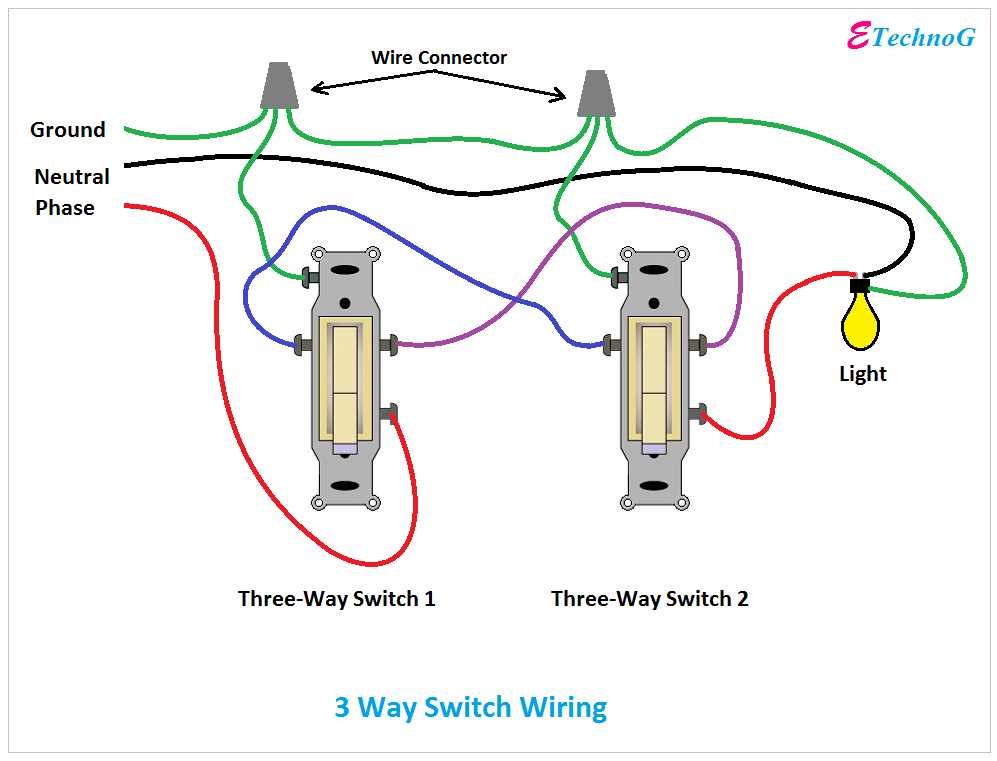
Connect the incoming phase conductor to the common terminal of the first control device. The second device receives the load conductor that leads to the lamp holder. Between these two devices run two traveler conductors that redirect the live path depending on the handle position.
The lighting state depends on how internal contacts route electricity between terminals. Each control device redirects the phase to one of two traveler lines. The lamp receives power only when both devices align along the same electrical route.
- Common terminal – carries either incoming phase or the load conductor toward the fixture
- Traveler conductor A – first path connecting both control devices
- Traveler conductor B – second path connecting both control devices
- Neutral conductor – runs directly from the panel to the lamp holder
- Ground conductor – bonds metal boxes and device frames
Handle movement changes which traveler wire carries the live feed. If both devices connect to the same traveler line, the electrical path reaches the lamp and illumination occurs. If each device selects a different traveler line, the path breaks and the lamp turns off.
- Phase enters the first wall control through the common terminal
- Internal contacts route the phase to one traveler wire
- The second control receives that traveler signal
- If its internal contact connects to the load terminal, current flows to the lamp
- If not, the electrical path stops and the fixture remains dark