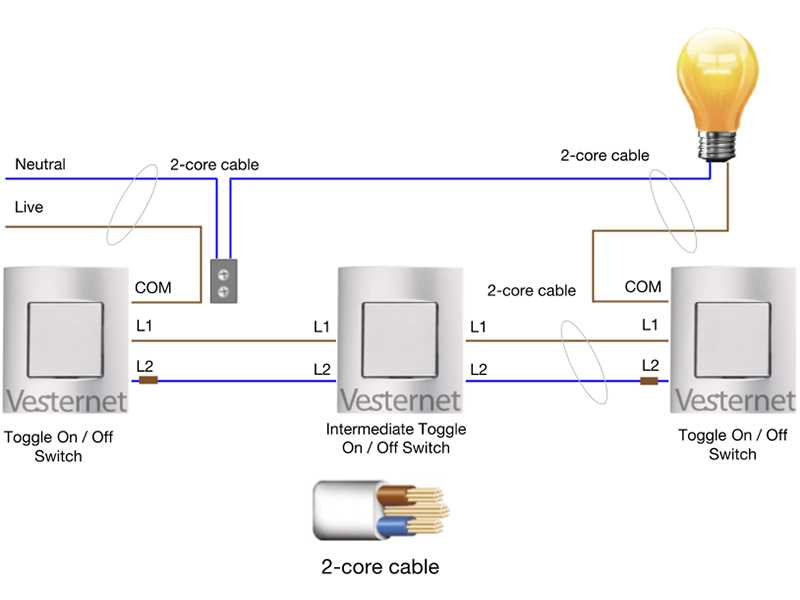
Use a three-location switching layout whenever one lamp must be controlled from two separate switches, such as at the top and bottom of a staircase or at opposite ends of a hallway. The configuration relies on two SPDT switches and a traveler pair. One terminal receives the phase conductor, two traveler terminals pass current between switches, and the final terminal connects to the lamp line. This structure allows either switch position to toggle the light regardless of the other switch state.
Correct conductor identification prevents installation errors. The incoming phase normally connects to the common terminal of the first switch, while the outgoing lamp lead attaches to the common terminal of the second switch. Between both switches run two insulated traveler conductors, typically marked with contrasting colors such as red and white. Neutral wiring bypasses the switching hardware and goes directly to the luminaire.
Electrical installers often route the cable using 14/3 or 12/3 sheathed wiring depending on breaker rating. A 15-amp branch uses 14-gauge conductors; a 20-amp branch requires 12-gauge copper. Ground conductors from both switch boxes and the light fixture must be bonded together and attached to the green terminal of each switch body to maintain protective grounding.
Placement also affects usability. Mount switches roughly 90–110 cm above floor level so both entry points allow comfortable access. In stair installations, one control unit sits near the first step and the second near the landing. With this arrangement, the lamp state can be changed from either location without returning to the original switch.
Three-Point Lighting Control Layout: Practical Guide to Understanding and Wiring
Disconnect the breaker and confirm zero voltage with a multimeter before touching conductors. A dual-switch lighting control setup uses two wall switches to operate one lamp from separate positions, such as opposite ends of a hallway or staircase. The first switch receives the live feed, the second sends power to the fixture, and two traveler conductors link both devices.
Identify terminals before connecting anything. Each switch has one darker screw called the “common” terminal and two lighter traveler terminals. The live supply attaches to the common screw on the first switch. The lamp lead connects to the common screw on the second switch. The remaining paired terminals handle the traveler wires that shuttle current between switches.
Use a 3-conductor cable with ground (commonly labeled 14/3 or 12/3 depending on breaker rating). Inside the sheath are black, red, white, and bare copper. In many installations the black carries the incoming line, red and white act as travelers, and the bare wire bonds to ground screws on both switches and the metal box.
Traveler connections must stay consistent across the pair of switches. Attach the red wire to one traveler terminal and the white wire to the second traveler terminal on the first switch. Mirror the same pair on the second switch. Orientation between the two traveler screws does not affect operation because the toggle simply alternates which traveler connects to the common contact.
At the lighting fixture box, connect the switched conductor from the second switch to the fixture’s hot lead. Neutral from the power source joins directly with the fixture neutral using a wire connector. This neutral bypasses both switches completely, a detail often misunderstood during troubleshooting.
Testing confirms proper installation. Restore power and flip either switch; the lamp should change state regardless of the other switch position. If the light only works when both toggles face the same direction, the common and traveler wires were likely mixed on one device.
Voltage readings help diagnose faults. Measure between ground and the common screw of the first switch; it should show approximately 120 V in North American systems. Traveler wires will alternate between energized and neutral potential depending on toggle position. Lack of voltage at the second switch common usually indicates a broken traveler conductor or loose terminal.
Label conductors during installation and avoid relying on insulation color alone, especially in older buildings where white wires may carry live current as travelers. Wrap a small band of black or red tape around any re-purposed neutral wire to signal that it functions as a live path in this lighting control configuration.