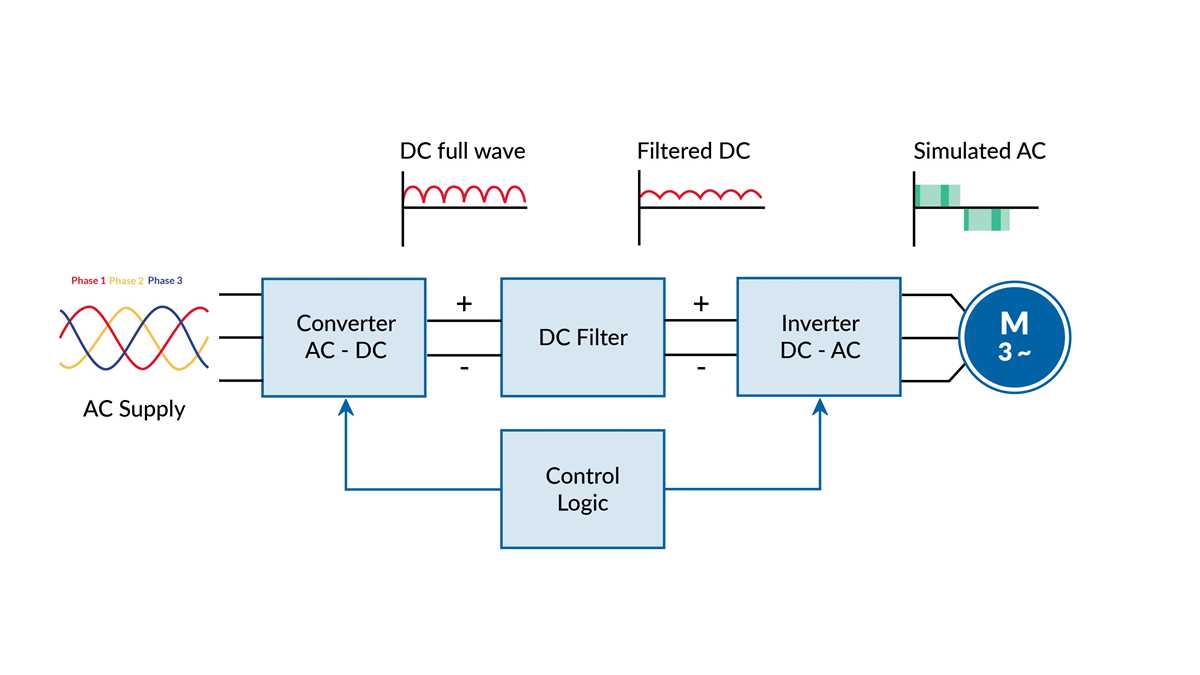
Check the AC supply rating before connecting a motor controller that adjusts rotational speed. Most industrial units accept 380–480 V three line input and convert it into a DC link using a bridge rectifier made from six power diodes. This stage converts alternating input from the mains into a stable direct current level stored inside large electrolytic capacitors.
The DC link section usually operates around 540–680 V depending on input voltage. Capacitors in this section smooth the rectified waveform and provide energy for the output switching stage. Many designs include a braking resistor and transistor that dissipate excess energy when the motor decelerates rapidly.
Output power to the motor comes from an inverter stage built with IGBT transistors arranged in three half bridges. A control board rapidly switches these transistors to produce synthesized AC output. By changing the switching pattern, the controller adjusts motor rotational rate while maintaining proper torque.
Control electronics monitor several signals during operation. Current sensors measure output load, temperature sensors track heatsink conditions, and voltage monitors supervise the DC link. If any parameter exceeds safe limits, the controller stops the switching stage and reports a fault code.
Trace the power path through each stage when analyzing a layout drawing. Input mains lines enter the rectifier bridge, the DC link stores energy, and the inverter block generates three controlled outputs connected to the motor terminals labeled U, V, and W.