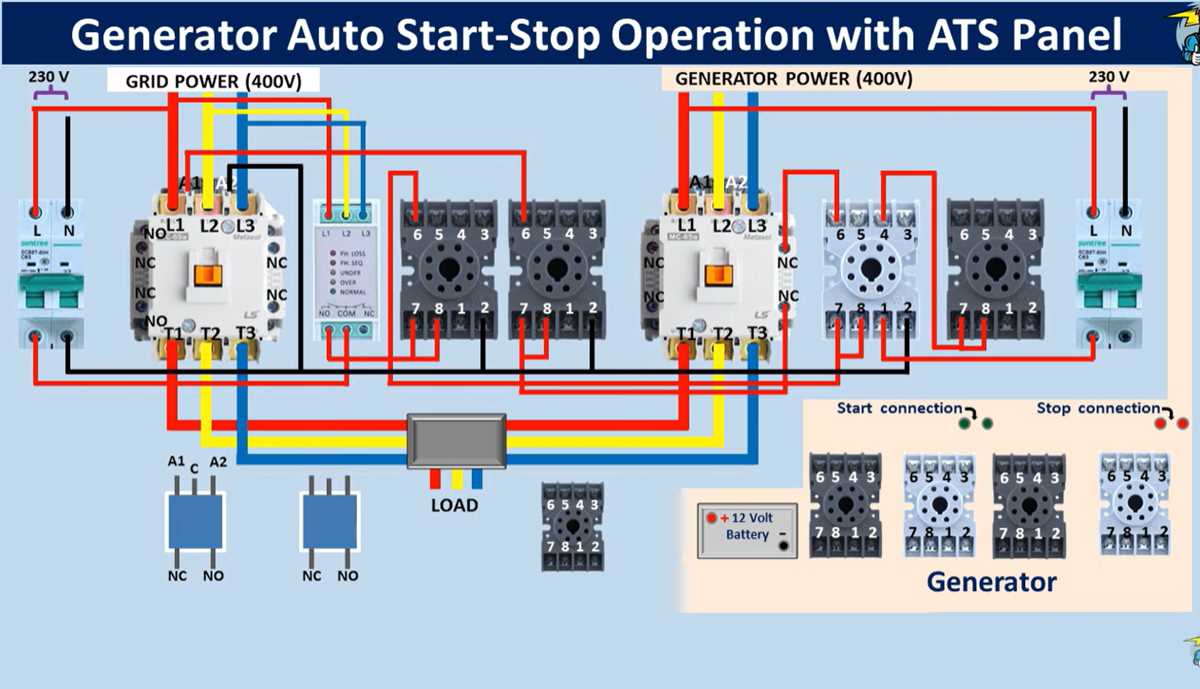
Use a balanced three-line supply with equal load distribution across L1, L2, and L3 conductors to prevent overheating of busbars and protective devices. In a typical 400/230 V European installation, each live conductor should carry similar current values; imbalance above 15–20 % increases thermal stress on terminals and switchgear. Arrange circuit breakers so that heavy consumers–motors, HVAC compressors, large ovens–are spread across the three incoming lines rather than grouped on one side of the distribution board.
Inside the distribution cabinet, connect the incoming three-line supply to copper busbars rated at least 125 % of the expected current. For example, with a main breaker rated at 63 A, busbars should support at least 80 A continuous load. Use conductor cross-sections of 16 mm² copper for the feeder at that rating, tightening terminal screws to manufacturer torque values, commonly 2.5–3.5 Nm for modular devices. Poor clamping pressure leads to localized heating that often exceeds 90 °C during peak demand.
Apply standardized conductor colors to avoid service errors. Brown, black, and grey identify the three live lines; blue marks the neutral return; green-yellow marks the protective earth. Route the neutral through a dedicated terminal strip separated from grounding bars. Sensitive equipment such as variable-speed drives or server racks benefits from neutral conductors sized equal to the live lines because harmonic currents may increase return current beyond 50 % of line load.
Arrange protective devices in vertical groups so that each outgoing circuit clearly corresponds to one of the three supply lines. A common layout places breakers in repeating order–L1, L2, L3–down the rail. This pattern simplifies troubleshooting and reduces the chance of connecting multiple high-power loads to the same line. Label each breaker with load description and rated current; a clear marking system shortens maintenance time and prevents accidental overload during equipment upgrades.
Three-Line Power Distribution Layout
Use three incoming conductors marked L1, L2, and L3 from the utility feeder and connect them to a main disconnect rated not lower than 125% of the calculated load. From this switch, route each conductor to separate busbars inside the distribution cabinet. Maintain clear color identification–commonly brown, black, and grey in IEC systems–to prevent cross-connection during maintenance. A neutral bar and protective earth bar must remain isolated from each another except at the service entry bonding point.
A typical layout divides outgoing circuits so that load is balanced across the three supply lines. For example, a workshop drawing 18 kW total may distribute 6 kW per line through three identical breakers. Each branch device should match conductor capacity; copper conductors of 4 mm² usually pair with a 25 A breaker under standard installation temperature of 30 °C. Place protection devices sequentially along the busbars so technicians can visually trace which outgoing circuit belongs to each supply conductor.
Install measurement equipment directly after the main disconnect. A three-channel energy meter connects through current transformers sized according to feeder current–common ratios include 100/5 A or 200/5 A. Voltage sensing leads attach to L1, L2, L3, and neutral. Arrange these sensing leads with dedicated miniature fuses rated near 2 A to prevent instrument damage during internal faults.
Cable routing inside the enclosure should follow a strict geometric order: incoming conductors enter at the top, busbars run horizontally, and outgoing circuits exit through lower glands. Maintain at least 20 mm spacing between energized copper bars rated up to 415 V. If the installation carries motors, place motor-protection breakers adjacent to contactors so control cables remain under 1 m, reducing electromagnetic interference.
Before energizing the assembly, verify torque on terminal bolts–typical M6 copper bar connections require roughly 5–6 N·m. Measure resistance between neutral and earth bars; it must exceed 1 MΩ before bonding at the service point. A clamp meter check should confirm current difference between the three supply lines remains under 10 %, preventing overheating and extending equipment life.
How to Read a 3-Line AC Distribution Schematic: Identifying Lines, Neutral, and Ground Connections
Check conductor labels such as L1, L2, and L3 first; these three marks indicate the three energized supply lines that carry alternating current from the service entrance toward breakers and loads. On most electrical drawings, these lines appear as parallel paths entering the distribution board from the top or left side. Trace each labeled path across the drawing and confirm that every load connects to one, two, or three of these supply lines depending on equipment requirements.
Neutral is usually marked with the letter N and shown returning toward the service source through a separate bus rail. Unlike energized lines, this conductor often appears grouped with multiple return paths from lighting circuits or receptacle branches. Its symbol typically connects to the transformer star point or service reference node. Verify that the N conductor never passes through protective switches designed only for energized lines.
Color and label conventions used on technical drawings
Many electrical layouts include color or code identifiers that help separate the three supply lines from neutral and protective earth.
- L1 commonly marked brown or black
- L2 commonly marked black or gray
- L3 commonly marked gray or blue-black depending on regional standards
- N marked light blue
- Protective earth marked green-yellow
Protective earth appears as a conductor linked to chassis points, enclosure frames, and grounding bars. On the drawing it often terminates at the earth symbol consisting of three horizontal lines of decreasing width. Unlike current-carrying lines, this conductor does not connect through load devices; instead it ties metal parts to the grounding network to route fault current safely.
Tracing conductor paths across the electrical drawing
Follow each path sequentially from the supply entry to the load terminals. Interruptions along the path usually represent protective components such as breakers or contactors. The goal is to determine which energized line feeds each device and where neutral returns.
- Locate L1, L2, L3 entry points.
- Trace each line through switching or protection elements.
- Confirm load terminals receiving one or multiple supply lines.
- Locate the neutral return path linked to the N bus.
- Identify earth connections tied to equipment frames.
Measurements written beside conductors also help interpretation. Typical industrial systems show values like 400 V between any two energized lines and 230 V between a line and neutral. If a motor symbol connects to three energized lines without neutral, it indicates a three-line load. Lighting circuits linking one energized line with N indicate single-line loads referenced to neutral.