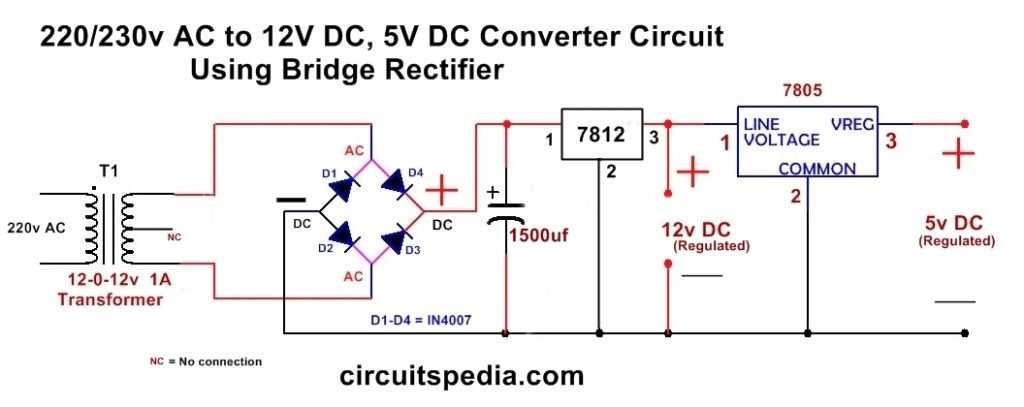
Verify the transformer rating matches the desired output before connecting to mains AC. Use a fuse on the input line to prevent overloads, and ensure the secondary winding provides adequate current for connected devices.
Install a bridge rectifier to convert alternating current to direct current. Check polarity at the output terminals and use a smoothing capacitor to reduce voltage ripple, ensuring stable operation for sensitive electronics.
Incorporate a voltage regulator after rectification to maintain a consistent DC level. Measure output under load to confirm that fluctuations remain within acceptable limits and adjust filtering if necessary.
Route all connections carefully, keeping high-voltage and low-voltage lines separate. Insulate exposed leads and mount components on a non-conductive base to prevent short circuits and accidental contact with live parts.
Guide to Converting 240V AC to 12V DC with Transformer Rectifier and Regulator Setup
Select a transformer that steps down the main voltage to a level slightly above the desired DC output to allow for voltage drop across the rectifier. Install a bridge rectifier after the secondary winding to convert alternating current to direct current, and add a filter capacitor to minimize ripple. Ensure all connections are insulated and mounted on a non-conductive base to prevent shorts.
Use a voltage regulator to maintain a steady DC output under varying load conditions.
- Measure output with a multimeter under full load
- Adjust capacitor size if ripple exceeds tolerance
- Separate high-voltage AC and low-voltage DC lines
- Secure all terminals with insulated connectors
Perform final testing by powering sensitive devices and confirming stable operation before permanent installation.
Selecting Transformer and Rectifier Components for Safe Voltage Conversion
Choose a transformer with a secondary voltage slightly higher than the target DC output to account for voltage drop across rectifying elements. Ensure the transformer current rating exceeds the total load demand to prevent overheating and maintain stability.
Verify insulation class and thermal limits of the transformer to withstand continuous operation. Proper mounting and secure terminals reduce mechanical stress and prevent accidental contact with live connections.
Select a bridge rectifier rated for at least 25–30% higher current than the expected draw. Check reverse voltage ratings to ensure components can tolerate peak secondary voltage and avoid breakdown under load.
Integrate filter capacitors immediately after the rectifier to smooth pulsating output. Calculate capacitance based on load current and acceptable ripple voltage, and secure components with insulated connectors to maintain reliable and safe DC conversion.