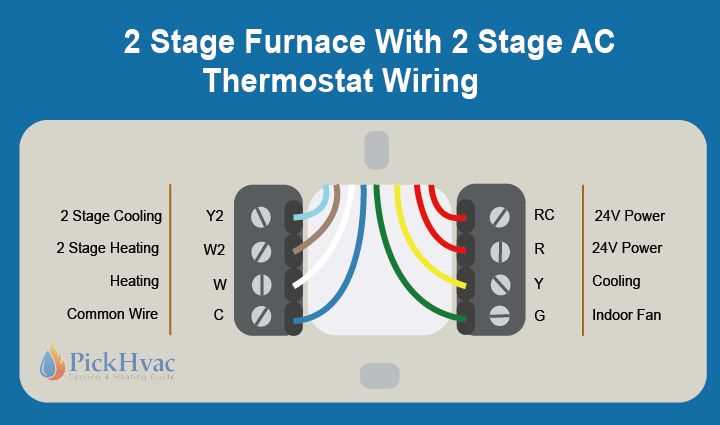
Connect the low-voltage control cable from the HVAC equipment to a two-level temperature controller using clearly labeled terminals such as R, C, Y1, Y2, W1, and W2. Each terminal controls a separate heating or cooling level, allowing the climate system to increase output only when additional temperature correction is required.
The 24-volt supply from the HVAC transformer normally connects to the R terminal, while the return conductor attaches to C. Cooling commands travel through Y1 and Y2 conductors, while heating signals use W1 and W2 connections. This structure lets the climate regulator activate the first level during moderate temperature change and engage the second level during larger demand.
Use a multi-core cable with at least six conductors so each function receives a dedicated lead. Typical color assignments include red for power supply, blue or black for common return, yellow leads for cooling control, and white leads for heating activation. Maintaining consistent color mapping helps technicians trace control paths during installation or service.
Mount the temperature controller on an interior wall roughly 1.5 meters above the floor and away from supply vents or direct sunlight. Cable routing should run through wall cavities toward the air handler control board. Correct placement and organized conductor routing prevent inaccurate temperature readings and simplify maintenance.
2 Stage Thermostat Wiring Diagram with Terminal Layout for Heating and Cooling Systems
Connect the climate controller terminals to the HVAC control board using labeled low-voltage conductors such as R, C, Y1, Y2, W1, and W2. The R terminal carries the 24-volt supply from the transformer, while C provides the return path. Cooling commands use Y1 for the first compressor level and Y2 for the second, while heating activation travels through W1 and W2 conductors.
Use a cable with at least six insulated conductors so each control path remains separate. Common color mapping simplifies service and installation.
- Red conductor connected to R terminal for 24 V supply
- Blue or black conductor connected to C terminal for return
- Yellow leads attached to Y1 and Y2 for compressor control
- White leads attached to W1 and W2 for heating activation
- Green lead connected to G terminal for indoor blower control
Mount the temperature controller on an interior wall approximately 1.5 meters above the floor. Position it away from supply vents, windows, and direct sunlight. Incorrect placement can cause inaccurate temperature sensing and unnecessary heating or cooling activation.
Follow a clear connection sequence during installation.
- Disconnect HVAC system power at the breaker panel
- Route the multi-conductor cable from the air handler control board to the wall control unit
- Attach each conductor to its labeled terminal
- Restore power and verify heating and cooling response
Label each conductor at both ends of the cable so service technicians can trace control paths without removing wall panels. Organized terminal connections reduce troubleshooting time when diagnosing compressor or furnace response problems.
Terminal Connections for R C Y1 Y2 and W1 W2 in a 2 Stage Thermostat Wiring Diagram
Connect the 24-volt supply conductor from the HVAC transformer to the R terminal. This line delivers control voltage to the wall climate controller. The C terminal attaches to the return conductor from the same transformer and completes the low-voltage control loop used by heating and cooling commands.
The first cooling level connects through the Y1 terminal. This conductor runs from the wall control unit to the compressor contactor on the outdoor condensing unit. When the temperature regulator calls for cooling at the primary level, the Y1 lead energizes the contactor coil and activates the compressor.
The Y2 terminal handles the additional cooling level used during higher temperature demand. This conductor links the controller to the second compressor control input or to a control board that enables higher output operation. Both Y1 and Y2 leads operate independently, allowing gradual temperature correction instead of immediate maximum output.
Heating control follows a similar layout using the W1 terminal. This connection runs to the furnace control board or heat pump auxiliary heating relay. When the controller requests heat at the initial level, the W1 lead energizes the furnace ignition sequence or heating relay.
The W2 terminal provides the additional heating level used during larger temperature differences. This conductor usually connects to a secondary heating relay or to the furnace control board input that activates higher heating capacity.
Typical terminal conductor roles
Most HVAC installations use a consistent mapping between terminals and cable colors.
R terminal – 24 V supply from transformer
C terminal – common return conductor
Y1 terminal – primary cooling compressor signal
Y2 terminal – secondary cooling compressor signal
W1 terminal – primary heating control line
W2 terminal – secondary heating control line
Use a multi-core thermostat cable containing at least six insulated conductors. Many installers choose an 18-gauge cable with eight conductors so spare leads remain available for future upgrades or accessories such as humidifiers.
Label each conductor at the air handler board and at the wall controller. Clear identification simplifies troubleshooting when diagnosing compressor response, furnace activation, or control voltage interruptions within the HVAC system.